How Do You Get Your Business Cited by ChatGPT and Perplexity?
You get cited by ChatGPT, Perplexity, and Google AI Overviews by making pages easy to retrieve and extract: put a direct answer near the top, use question-shaped headings with short self-contained answers, add lists or tables, cite real sources, and keep the HTML crawlable. That practice is Generative Engine Optimization (GEO). It sits on top of solid SEO, not instead of it.
- ›What is Generative Engine Optimization (GEO)?
- ›How is GEO different from SEO?
- ›Why does AI citation matter for a business in 2026?
- ›How do ChatGPT, Perplexity, and AI Overviews pick sources?
- ›What on-page changes actually improve citation odds?
- ›How do you measure whether GEO is working?
- ›How does AutomaTeam apply GEO on client sites?
What is Generative Engine Optimization (GEO)?
Generative Engine Optimization (GEO) is the practice of structuring content and authority so AI answer engines cite, quote, or recommend you inside synthesized answers. The unit of winning is often a clear passage, not only a whole-page keyword rank.
The name comes from academic work led by Pranjal Aggarwal and collaborators (IIT Delhi / Princeton), published as GEO: Generative Engine Optimization (ACM SIGKDD 2024, arXiv:2311.09735). They studied how content rewrites change visibility inside generative engines that retrieve sources, write an answer, and cite passages.
You will also hear AEO (Answer Engine Optimization), AI SEO, or LLMO. Those labels mostly describe the same goal with different emphasis. AutomaTeam treats GEO as the outcome (get cited or absorbed into the answer) and AEO as the on-page extractability tactics that support it.
How is GEO different from SEO?
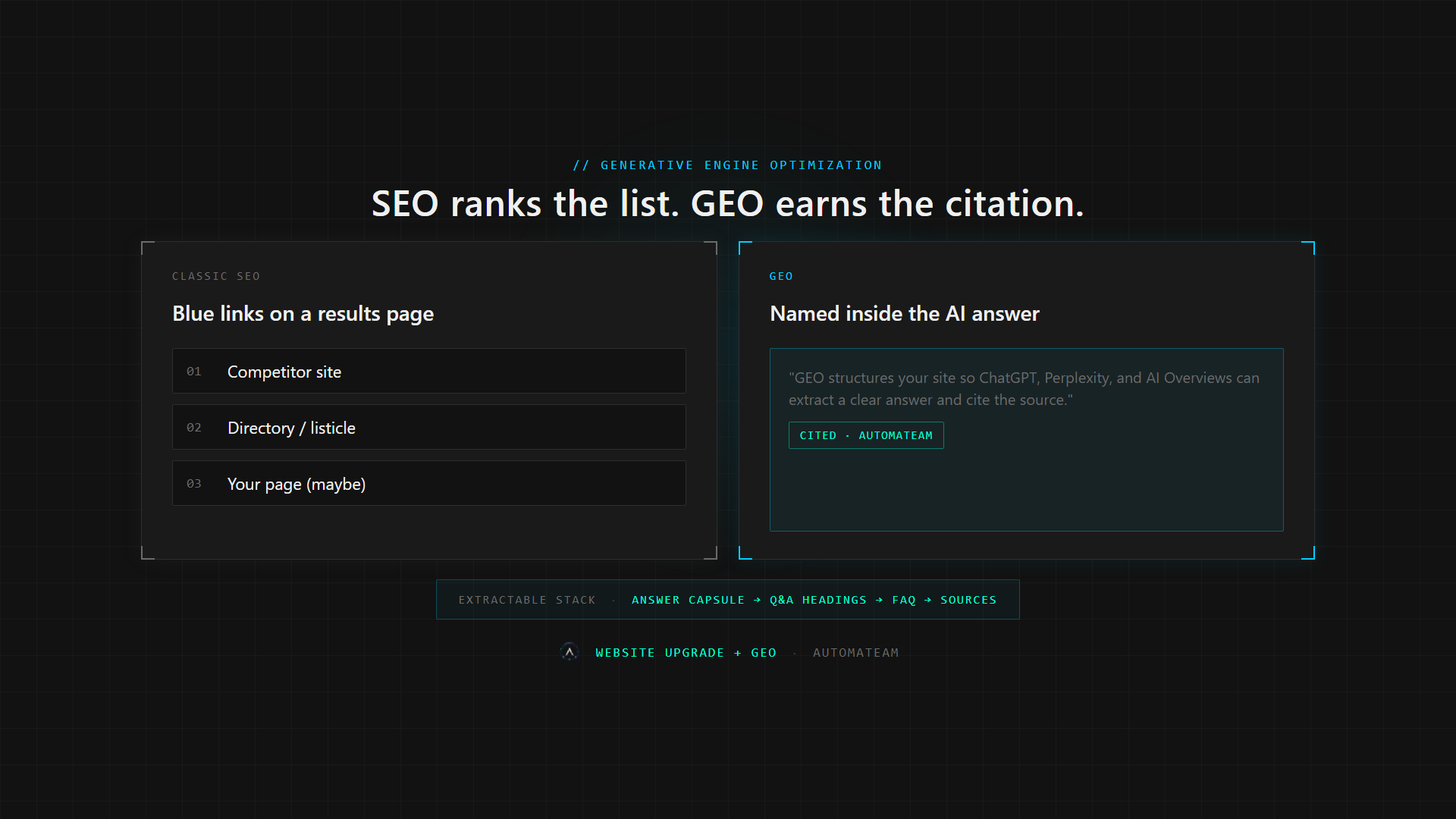
SEO optimizes for ranking and clicks on a results page. GEO optimizes for being selected and used inside an AI-written answer. Google's 2026 guidance on generative Search features still treats useful, crawlable, trustworthy pages as the foundation, so GEO is an additive layer, not a replacement.
In May 2026, Google's public stance on generative AI features in Search (summarized in TechTimes' GEO guide, citing Search Engine Journal) boiled down to this: optimizing for those features is still SEO. Same basics apply: useful content, crawlable HTML, clear structure, trustworthy experience.
- SEO success: your URL appears high in the blue-link list and earns the click.
- GEO success: the model names you, links you, or reuses your facts inside the answer even when the user never scrolls a SERP.
- Overlap: pages that already rank and read clearly tend to perform better in AI Overviews.
- Gap: a page can rank and still lose the answer slot if its claims are vague, buried, or hard to extract.
If you only chase keywords and ignore passage clarity, you are optimizing yesterday's interface. If you only chase AI formatting and ignore indexing, crawl access, and topical authority, the engines may never fetch you in the first place.
Why does AI citation matter for a business in 2026?
Buyers increasingly ask ChatGPT, Perplexity, Claude, and Google AI Overviews before they click ten blue links. If your competitor is the source the model trusts, you lose the conversation before your homepage loads. Citation is distribution for the answer layer.
OpenAI reported ChatGPT above 900 million weekly active users in late February 2026 (as summarized in TechTimes' 2026 GEO overview, up from earlier 2025 figures). Exact traffic share from AI referrals is still small versus total web traffic in many datasets, but growth is steep and the buying journey already includes an AI step for many B2B questions.
For AutomaTeam clients, that means a modern site is not only "pretty and fast." It should answer the questions your buyers type into AI tools: what you do, who it is for, what it costs to start, and what proof you have. That is why Website Upgrade + GEO is a product, not a buzzword tacked onto a redesign.
How do ChatGPT, Perplexity, and AI Overviews pick sources?
Most systems retrieve candidate pages, chunk passages, then synthesize an answer. ChatGPT often cites fewer sources but absorbs them deeper. Perplexity and Google-style overviews often cite more broadly and lean harder on freshness and existing search signals. Exact weights differ by product and change over time.
Under the hood you are usually looking at retrieval-augmented generation: find relevant passages, write an answer, attach citations. That is why a self-contained 50-word answer under a clear heading beats a long essay that buries the point in paragraph seven.
- Fetch: can the bot reach and read your HTML? Robots rules, noindex, and JS-only content kill you here.
- Parse: can it find a clean claim? Headings, lists, tables, and FAQ blocks help. Walls of prose and tab-hidden copy hurt.
- Generate: among fetched pages, which passage is specific and trustworthy enough to reuse?
2026 measurement research on citation selection versus absorption (arXiv:2604.25707) makes a useful distinction: being listed as a source is not the same as shaping the wording of the answer. Aim for both: crawlable authority (selection) and quotable evidence (absorption).
What on-page changes actually improve citation odds?
The moves that help most are answer-first openings, question-shaped sections with 40 to 60 word capsules, verified statistics, outbound citations, and clean structure (lists, tables, FAQ). Princeton GEO-bench found statistics, quotations, and source cites among the strongest rewrite methods. Keyword stuffing did not help.
In the GEO-bench study, targeted rewrites improved visibility by up to about 40% on their Position-Adjusted Word Count metric in that research setup. Treat that as an upper bound in a controlled experiment, not a guaranteed traffic promise for your site. Method quality still varied by domain.
- Answer the buyer question in the first screen. No throat-clearing intro.
- Make each H2 a question, then open with a self-contained capsule before the depth.
- Add numbers you can defend: ranges, dates, volumes, costs. Invented stats backfire.
- Cite primary sources inline when you make external claims.
- Use lists or tables for processes and comparisons.
- Ship FAQ answers that make sense alone (good for people and for FAQPage schema).
- Keep main content in server-rendered HTML, not locked behind client-only widgets.
- Allow reputable AI crawlers in robots.txt when you want answer-engine discovery.
Structure itself is a lever. GEO-SFE research (arXiv:2603.29979) reported roughly mid-teens percent citation-rate lifts from structural feature work in their experiments. Again: research bound, not a KPI contract. Practically, it means your outline and chunking matter as much as your adjectives.
A simple GEO vs SEO checklist
- Keep doing: technical SEO, topical pages, internal links, Core Web Vitals, honest E-E-A-T signals.
- Add for GEO: answer capsules, extractable FAQs, evidence density, freshness dates that match reality.
- Stop doing: keyword stuffing, invisible text, accordion-only article bodies, hype without sources.
How do you measure whether GEO is working?
Track prompt-level citation, not only keyword rank. Pick the questions buyers ask, run them on a schedule in ChatGPT, Perplexity, and Google AI Overviews, and log whether you are linked, named, or absorbed into the answer wording.
- Build a prompt list: 10 to 30 real buyer questions in your category.
- Record engine, date, whether you were cited, and whether your facts appeared in the answer.
- Note competitors who win the slot and what their passages look like.
- Refresh winning pages quarterly with updated numbers and a real dateModified.
Paid tools (for example Semrush AI visibility features or Ahrefs Brand Radar) can scale that monitoring. A spreadsheet and a weekly habit still beat waiting for a magic GEO score. Search Console remains useful for the SEO foundation underneath.
How does AutomaTeam apply GEO on client sites?
AutomaTeam's Website Upgrade + GEO package combines a design refresh with on-site GEO work: answer capsules, FAQ structure, schema where it matches visible content, crawl clarity, and copy shaped for AI extraction. Summer promo pricing on the site is $500 against an $800 list, or free with an automation build.
We do not sell "guaranteed ChatGPT placement." Engines change. What we do sell is a site that answers clearly, cites what it claims, and is easy for both Google and answer engines to parse. That is the same discipline we use on automa-team.com/blog.
- Scope the buyer questions your site must win.
- Rewrite key pages with answer-first structure and evidence.
- Ship technical basics: indexability, metadata, FAQ/Article schema that mirrors the page.
- Point you at a short prompt checklist so you can spot-check citations after launch.
See Website Upgrade + GEO on Solutions, current numbers on Scope & Cost, or book a Strategic Scope call if you want this done on your domain instead of as a weekend project.
Frequently asked questions
What is Generative Engine Optimization (GEO)?
GEO is the practice of structuring content and authority so AI answer engines such as ChatGPT, Perplexity, and Google AI Overviews cite, quote, or recommend you inside the answers they generate. The goal is to be part of the synthesized answer, not only a ranked blue link.
Is GEO the same as SEO?
No, but they overlap. SEO targets rankings and clicks on search results pages. GEO targets selection and use inside AI-written answers. Google's 2026 guidance on generative Search features still treats classic SEO foundations as necessary, so treat GEO as an additive layer.
How do I get cited by ChatGPT and Perplexity?
Make pages crawlable, put a direct answer near the top, use clear question-and-answer sections, add verified statistics and source links, and include FAQ blocks that stand alone. Then test your target prompts and refresh pages that almost win.
Does keyword stuffing help with GEO?
No. In the Princeton GEO-bench study, keyword stuffing was ineffective or harmful compared with adding statistics, quotations, and citations. Specific, well-sourced claims beat repeated keywords.
Can AutomaTeam add GEO to an existing website?
Yes. Website Upgrade + GEO is built for that: design refresh plus on-site GEO structuring. Check current promo pricing on the Solutions and Scope & Cost pages, or book a Strategic Scope call for a fit check.
See what this looks like for your business
Book a free 15-minute Strategic Scope. We map your manual work and tell you honestly what is worth automating.