What Does OpenAI Presence Mean for Small Businesses That Need AI Agents?
OpenAI Presence (announced July 22, 2026) is a managed enterprise product for governed AI agents: policies, simulations, human escalation, and deployment led by Forward Deployed Engineers. It is not self-serve. For small and mid-size businesses, the takeaway is not "buy Presence." It is that production agents need builders, guardrails, and ongoing maintenance, which is the same delivery model AutomaTeam sells as custom agent teams.
What is OpenAI Presence?
OpenAI Presence is OpenAI's enterprise platform for putting AI agents into real customer and internal workflows with policies, guardrails, simulations, and human escalation. Deployments are led by OpenAI Forward Deployed Engineers and select systems integrators. It is not a self-serve API product.
OpenAI described Presence on July 22, 2026 as a product for trusted agents that can answer questions, use company systems, take approved actions, and hand off to people when needed. Before go-live, teams can simulate common requests and edge cases. After go-live, production signals feed an improvement loop (OpenAI ties this to Codex) so changes get tested before they roll out.
Coverage from SiliconANGLE and The Register stresses the same point: this is a high-touch path. Limited general availability. Engineers in the room. Pricing scoped per customer. Not "paste your API key and hope."
Why does Presence matter if I will never buy it?
Presence matters because OpenAI is publicly admitting that agents in production need scoping, integration, testing, approval, and maintenance. That is the hard part. Models are the easy part. If the largest model company is packaging engineers with the product, smaller businesses should stop shopping for chatbots and start shopping for delivery.
A lot of SMB buying still sounds like this: "We got ChatGPT. Why do we need a team?" Presence answers that from the other end of the market. Even with frontier models, OpenAI will not let Presence become production-ready by dumping documents into a prompt. Their own framing: each deployment needs scoping, integration, testing, review, and approval before launch.
- Agents that act (refund, schedule, write, send) need permission boundaries.
- Bad edge cases need simulation before customers see them.
- Someone has to wire the CRM, inbox, and tools, then keep them wired.
- Someone has to own failure modes when the agent escalates or fails a check.
That list is not enterprise trivia. It is the difference between a demo and a system that runs next Tuesday without you babysitting it.
What should a small business take from the Presence launch?
Treat "who builds and maintains this" as part of the product. Prefer a scoped agent team with human checkpoints over a self-serve chatbot wrapper. You do not need OpenAI's limited GA program. You do need the same ingredients: clear job, tool access, guardrails, and a human who owns the system after week one.
Translate Presence into SMB language:
- Pick one job with a clear "done" state (enriched leads in a sheet, draft posts awaiting approval, triaged inbox).
- Give the agents only the tools that job needs.
- Write the rules: what they may do alone, what needs your OK, when to stop.
- Test on real samples before anything sends or publishes.
- Keep a maintainer. Models change. APIs break. Prompts drift.
If a vendor only sells you model access and a dashboard, you are buying the cheap layer. Presence is OpenAI selling the expensive layer: people who make agents behave in a real company.
How is OpenAI Presence different from a custom AI agent team?
Presence is OpenAI's branded, limited-GA enterprise stack with their engineers and governance tooling. A custom AI agent team is a workflow built for your tools and budget, often by a specialist firm, with supervisors, specialists, checks, and human approval on outbound actions. Same problem class. Different buyer and packaging.
Use this comparison when you are evaluating options:
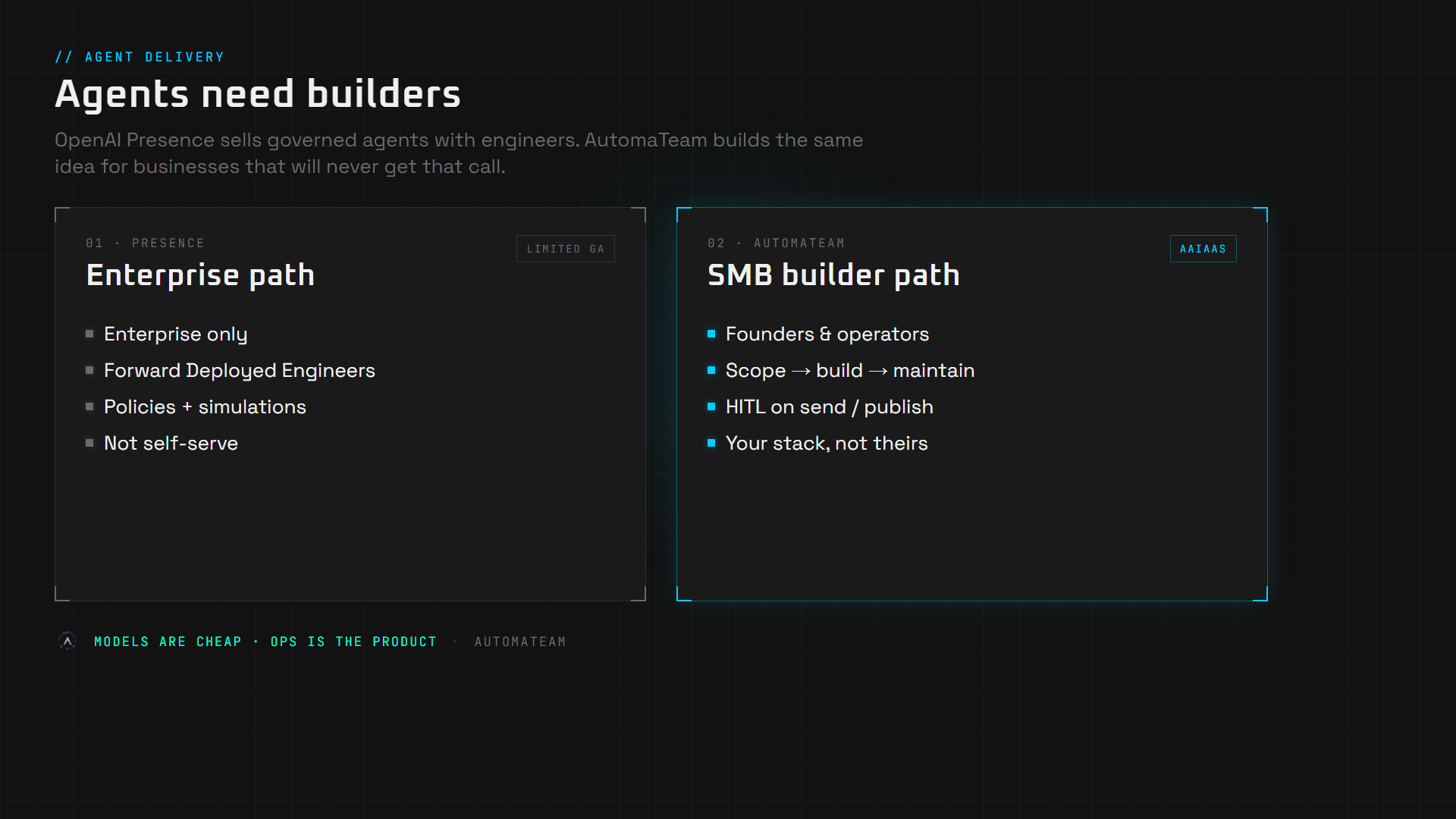
- Buyer: Presence targets eligible enterprises. Custom teams target founders and operators who will not get an OpenAI FDE.
- Access: Presence is limited GA, not self-serve. Custom builds start from a scope call and your stack.
- Governance: Presence emphasizes policies, sims, and approved actions. Good custom work does the same with HITL gates on send and publish.
- Stack: Presence sits inside OpenAI's deployment motion. Custom teams usually wire CRM, Sheets, email, and chat tools you already pay for.
- Ongoing cost: both assume someone stays after launch. Presence packages that as OpenAI/SI delivery. AutomaTeam packages it as AAIaaS (build plus optional retainer).
For the plain pattern behind custom crews, see What is an AI agent team? and AI agent trends in 2026.
How does AutomaTeam fit this moment?
AutomaTeam builds and runs custom AI agent teams for businesses that need production workflows without enterprise Presence access. You get scoped specialists, orchestration into your tools, self-checks, and human approval before anything leaves the building. The Presence launch is market proof that this delivery model is the product.
Flagship example: the Lead Gen Engine runs Prospect → Analyze → Copywrite into a sheet of enriched leads and draft emails. Social Media Crew is dogfooding the same idea for content (not client-ready yet). Solo agents cover narrower jobs. White-label is for agencies that want to resell the build.
- Map the manual loop on a short Strategic Scope call.
- Build against your real tools, not a sandbox demo.
- Approve sample output before anything runs live.
- Optional retainer for monitoring and small fixes.
Indicative pricing lives on Scope & Cost. If you want the hire-versus-automate math later, that post is next on the roadmap. For now: book a Strategic Scope call if you have one workflow that is eating the week.
Frequently asked questions
What is OpenAI Presence?
OpenAI Presence is a managed enterprise product for deploying governed AI agents in customer and internal workflows, with policies, simulations, human escalation, and deployment led by Forward Deployed Engineers. OpenAI announced it on July 22, 2026. It is not available as a self-serve product.
Can a small business buy OpenAI Presence?
Presence is rolling out through limited general availability for eligible enterprise customers with OpenAI engineers and select systems integrators. Most small businesses will not be on that path. The useful lesson is still the delivery model: agents need builders, guardrails, and maintenance.
Do I need OpenAI Presence to run AI agents in my business?
No. You need a clear job, tool access, checks, and a human who owns the system. That can be a custom agent team on tools you already use. Presence is one enterprise packaging of that idea, not the only way to get production agents.
How is a custom AI agent team different from ChatGPT?
ChatGPT answers prompts. A custom AI agent team runs a multi-step workflow with specialized agents, tools, structured handoffs, and human approval before send or publish. See AutomaTeam's explanation of AI agent teams for the full pattern.
What should I automate first after reading about Presence?
Pick one repetitive loop with a clear output: lead research and draft outreach, inbox triage, or a social content draft pipeline with approval. Scope the human checkpoints first, then build. AutomaTeam starts with a free 10-minute Strategic Scope call.
See what this looks like for your business
Book a free 15-minute Strategic Scope. We map your manual work and tell you honestly what is worth automating.
AI Agent Trends in 2026: Multi-Agent Teams, Self-Correcting Loops, and Subagents
The 2026 shift is from single chatbots to multi-agent teams: specialists that call subagents, check their own work in self-correcting loops, and stay under human approval for anything that ships.
What Is an AI Agent Team and How Does It Automate Business Workflows?
An AI agent team is a group of specialized AI programs that each run one step of a workflow and hand off to the next. Here is how that differs from a chatbot, and what it actually automates.