What Is an AI Agent Team and How Does It Automate Business Workflows?
An AI agent team is a group of specialized AI programs that each handle one step of a workflow: research, analysis, writing, then sending. Each one passes its output to the next automatically. Unlike a single chatbot such as ChatGPT, the team runs a whole process end to end without a person prompting every step.
How is an AI agent different from a chatbot like ChatGPT?
A chatbot answers one prompt at a time and waits for you. An AI agent has a goal, can use tools, and takes several steps on its own to reach it. ChatGPT writes the email when asked. An agent finds the lead, researches it, writes the email, and files it, without being prompted at each step.
The difference is autonomy. A chatbot is reactive. You ask, it responds, the loop ends. Tools like ChatGPT, Claude, and Gemini are strong at that single turn, but they do not go and do anything afterward unless you keep prompting.
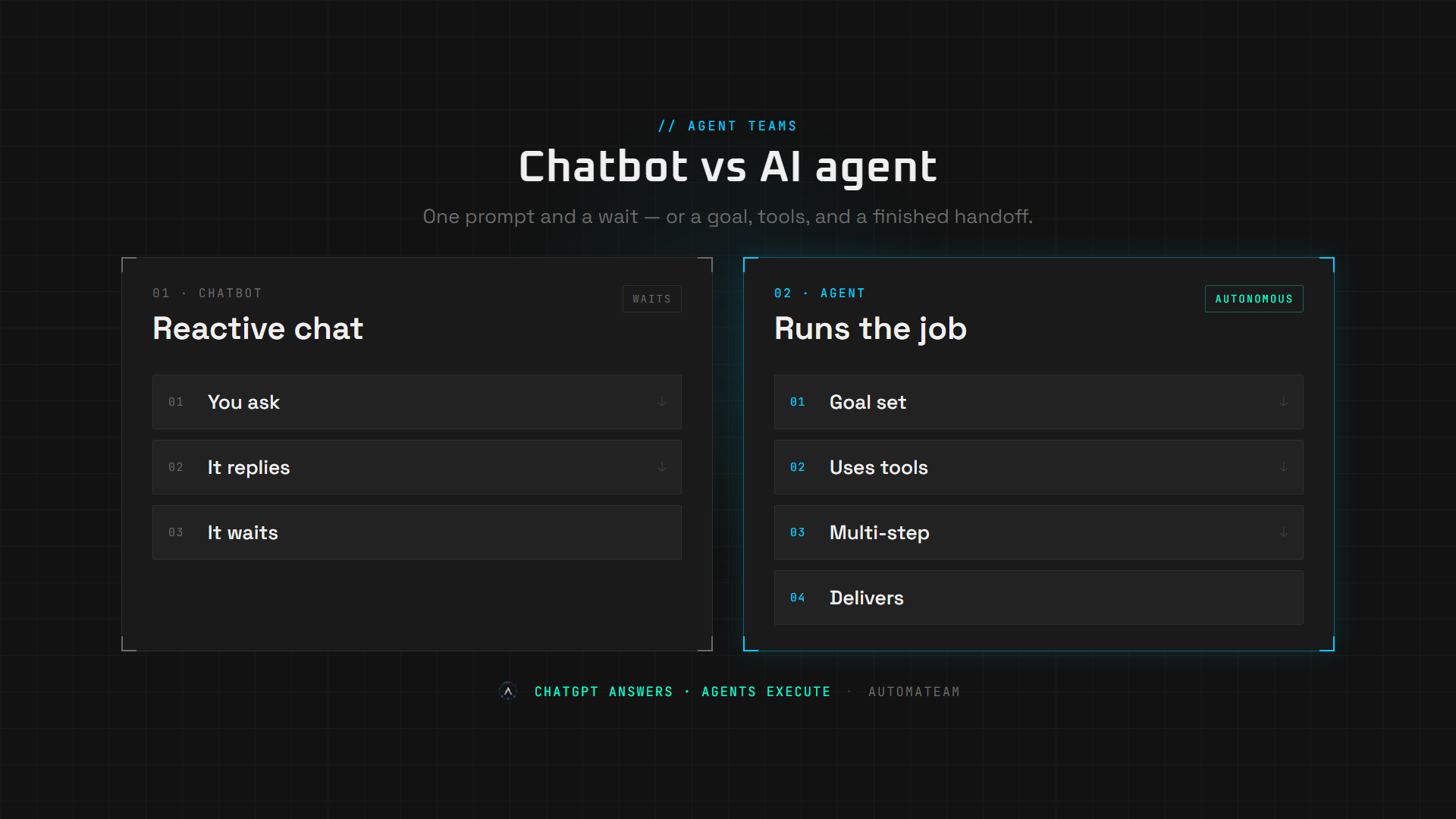
An agent is given an objective and the means to act on it: access to a search tool, a website, a spreadsheet, an inbox. It decides the steps, runs them, checks the result, and moves on. The model is the brain; the tools and the goal are what make it an agent.
What does an AI agent team actually look like?
An AI agent team is usually one supervisor agent and several specialists. The supervisor breaks the job into steps and routes work. Each specialist owns one task it does well, then hands its output to the next. It mirrors a small department, except it runs 24/7 and never drops a handoff.
Think of how a sales team is structured. Someone builds the target list, someone researches each account, someone writes the outreach. An agent team copies that division of labor, with each role played by a model tuned and instructed for that one job.
Our Lead Gen Engine is a working example of this pattern:
- Prospector: finds businesses that match your target niche and location.
- Analyst: visits each website and pulls real, verifiable pain points.
- Copywriter: writes a personalized cold email using those specifics.
- Supervisor: sequences the work and assembles the final output.
The plumbing that connects them is an orchestration layer such as n8n, which passes the output of one agent straight into the next. You do not see the wiring. You see a finished sheet of enriched leads and ready-to-send emails. Step-by-step detail lives in How to automate lead generation with AI agents.
What business workflows can an AI agent team automate?
Agent teams fit any workflow that is repeatable, rules-based, and high-volume. The strongest cases today are lead generation, cold outreach, social content production, data entry and enrichment, and inbox and scheduling. Strategy, relationships, and final judgment calls stay with people.
A simple test: if a task is repetitive, follows a pattern, and eats hours every week, it is a candidate. The best first targets we see:
- Lead generation and prospecting, replacing manual list-building and research.
- Cold outreach, with personalized drafts written per lead instead of one template blasted to everyone.
- Social content, turning a brief or topic into platform-ready posts across channels.
- Data work, pulling, cleaning, and enriching records across your CRM and sheets.
- Inbox and scheduling, triaging mail and proposing meeting times for human approval.
What you should not hand over: deciding strategy, owning client relationships, and the final yes or no on anything sensitive. The goal is to delete the busywork around those decisions, not the decisions themselves. For fifteen industry-shaped examples, see What can AI agents do for my business?.
How does AutomaTeam build and run an agent team?
We scope the workflow on a short call, build the agent team against your real tools, and let you approve it before anything goes live. Then it runs in production and we maintain it. You get a working system on your stack, not a template you have to wire up yourself.
Most automation shops sell you a template and disappear. We build custom, deploy into the tools you already use, and stay on to keep it running when a platform changes its API or an edge case appears.
- Scope: a free 15-minute call to map what is manual, what it costs, and what repeats.
- Build: we assemble the agent team for your workflow and stack.
- Approve: you review the system before it touches anything live.
- Run and maintain: it operates 24/7 and we keep it healthy.
You can see the full catalog on the Solutions page, check Scope & Cost, or book a scope call and we will tell you honestly whether your workflow is worth automating.
Is an AI agent team worth it for a small business?
For most small businesses, yes, when the work is repetitive and currently done by a person. A single agent starts at $500 to build; a full multi-agent team from $1,000. Compare that to one SDR or VA salary and the system usually pays for itself within months.
A sales development rep spends three or more hours a day on research and writing. An agent team does the same volume in minutes, every day, without overtime or turnover. The math is rarely close once a task is genuinely repetitive.
The honest caveat: automation is not free to run. A system needs monitoring and the occasional fix when a tool it depends on changes. That is what the optional monthly retainer covers. If a workflow is low-volume or changes constantly, a human is still the better call, and we will say so.
Frequently asked questions
How is an AI agent different from ChatGPT?
ChatGPT answers a single prompt and waits for the next one. An AI agent is given a goal and the tools to reach it, then takes multiple steps on its own, such as searching, reading a site, writing, and saving the result, without you prompting each step.
What can an AI agent team do for my business?
It can take over repetitive, high-volume workflows: finding and researching leads, writing personalized outreach, producing social content, cleaning and enriching data, and managing inbox and scheduling. Strategy and final approvals stay with you. For fifteen industry examples, see What can AI agents do for my business?.
How long does it take to build an AI agent team?
A single-task agent is usually a few days. A full multi-agent team depends on the integrations and scope, and is typically one to two weeks. We give you a timeline after the scope call, once we have seen the actual workflow.
Do I still control what the agents do?
Yes. You approve the system before it goes live, and we keep human checkpoints on anything sensitive, such as sending or publishing. The agents remove the busywork; you keep the decisions.
What is a multi-agent system?
A multi-agent system is several specialized AI agents coordinated by a supervisor or orchestration layer so each owns one step of a workflow and passes structured results to the next. AutomaTeam builds these as custom systems on tools you already use, not as a single chat window.
See what this looks like for your business
Book a free 15-minute Strategic Scope. We map your manual work and tell you honestly what is worth automating.
What Does OpenAI Presence Mean for Small Businesses That Need AI Agents?
OpenAI Presence sells governed enterprise agents with Forward Deployed Engineers. Here is what that launch means if you are a founder who needs agents built and maintained, without an enterprise deal.
AI Agent Trends in 2026: Multi-Agent Teams, Self-Correcting Loops, and Subagents
The 2026 shift is from single chatbots to multi-agent teams: specialists that call subagents, check their own work in self-correcting loops, and stay under human approval for anything that ships.