AI Agents vs. Hiring: Should You Automate or Add Headcount in 2026?
For repetitive, high-volume work, an AI agent usually beats hiring: a one-time build plus a low monthly retainer replaces recurring salary, runs 24/7, and keeps the same quality at lead 100 as at lead 1. For judgment, relationships, and strategy, a human still wins. The strongest setup in 2026 is a lean team with agents on the busywork.
Should you hire or automate with AI agents?
Automate the work that is repetitive, rules-based, and high volume. Hire (or keep) humans for judgment, relationships, and exceptions. If a task burns hours every week and the output shape barely changes, an agent is usually the better next seat than another salary.
Founders often frame this as a binary: fire people or stay manual. That is the wrong frame. In May 2026, TIME reported on Sonora, an online guitar school that cut from 48 people to 30 after agentic AI took over setter outreach, onboarding support, and parts of ops, while holding revenue and saving roughly $250,000 a year in software alone. Other operators, like Hospitable in the same piece, spent the equivalent of three full-time salaries on AI, answered most support with agents, and reduced hiring without layoffs.
In July 2026, hospitality software company Mews cut about 15% of staff and named AI as the structural reason: one person can own a workflow end to end when agents collapse handoffs. That is an enterprise signal. For a small business, the useful version is simpler: put agents on volume, keep humans on the close and the brand.
AutomaTeam builds that hybrid on purpose. We map what is manual and repeatable, ship a custom agent or agent team into your stack, and keep humans in the loop where a bad send costs trust. For how those teams are structured, see What is an AI agent team?.
What does a hire actually cost in 2026?
A U.S. SDR seat often costs $110,000 to $160,000 fully loaded in year one once you add benefits, tools, manager time, ramp, and turnover risk. A full-time virtual assistant is cheaper in cash terms, usually hundreds to a few thousand dollars a month, but still burns finite hours and needs management.
Sales development (SDR) seat
Headline base pay for a U.S. SDR commonly lands around $55,000 to $65,000, with on-target earnings often near $80,000 to $95,000. That is not the budget number. Industry breakdowns that include benefits, sales tooling, management overhead, ramp drag, and attrition put a realistic year-one seat near $110,000 to $160,000+, with some mid-market models clustering around $150,000.
- Ramp to full productivity: typically 3 to 4 months (longer at seed-stage companies with a fuzzy ICP)
- Voluntary SDR turnover: often cited around 35% to 40% per year
- Median tenure: often in the 14 to 16 month range before you pay to replace and re-ramp
- Cost-per-hire: recruiter fees plus internal time commonly add several thousand dollars before day one
Virtual assistant
A full-time Philippines-based VA in 2026 often runs about $700 to $1,200 per month for mid-level direct hire, or roughly $1,200 to $2,500 per month through a managed agency, depending on skill and oversight model (market roundups for 2026). U.S.-based VA rates are much higher, commonly $20 to $40+ per hour for comparable admin and ops work.
A VA is often the right move when the work is messy, exception-heavy, or needs a human inbox presence. A VA is a weaker fit when you need the same research-and-draft loop applied to 100 leads with consistent depth. Humans get tired. Agents do not.
What does a custom AI agent actually cost?
At AutomaTeam, a solo agent build starts from $500 and a multi-agent team from $1,000, with optional retainers from $100 per month and extra work at $50 per hour. You pay once to scope and ship, then a small ongoing fee if you want monitoring and changes, not a second payroll line.
Shelf tools charge subscriptions forever and still leave you to wire the workflow. A custom build is closer to hiring an engineer for a defined system, then keeping a light maintenance lane. Line items on our Scope & Cost page:
- Build fee (one-time): solo agent from $500; multi-agent team from $1,000
- Dev hours (as needed): $50/hr for extra integrations or logic
- Retainer (optional): from $100/mo for monitoring, API fixes, and monthly tune-ups
- You own the code; the system runs in your tools (Sheets, CRM, inbox, n8n, and so on)
Compare that to paying $9,000+ per month fully loaded for one SDR seat, or $1,000 to $2,500 per month for a VA who still finishes when their shift ends. Year one for a lead-gen or ops agent team is usually a few thousand dollars in build plus a four-figure retainer band, not six figures of salary. Exact numbers land on a free Strategic Scope call because workflow complexity and integrations move the quote.
For a concrete volume example, our Lead Gen Engine style pipeline returns about 100 enriched leads with personalized drafts in roughly 10 minutes of machine time. See How to automate lead generation with AI agents.
AI agent vs VA vs SDR: how do the options compare?
An SDR seat buys human judgment and relationships at six-figure fully loaded cost with ramp and turnover. A VA buys cheaper human hours with finite capacity. A custom AI agent buys 24/7 throughput on a fixed workflow for a build fee plus a small retainer, with a human reviewing high-risk outputs.
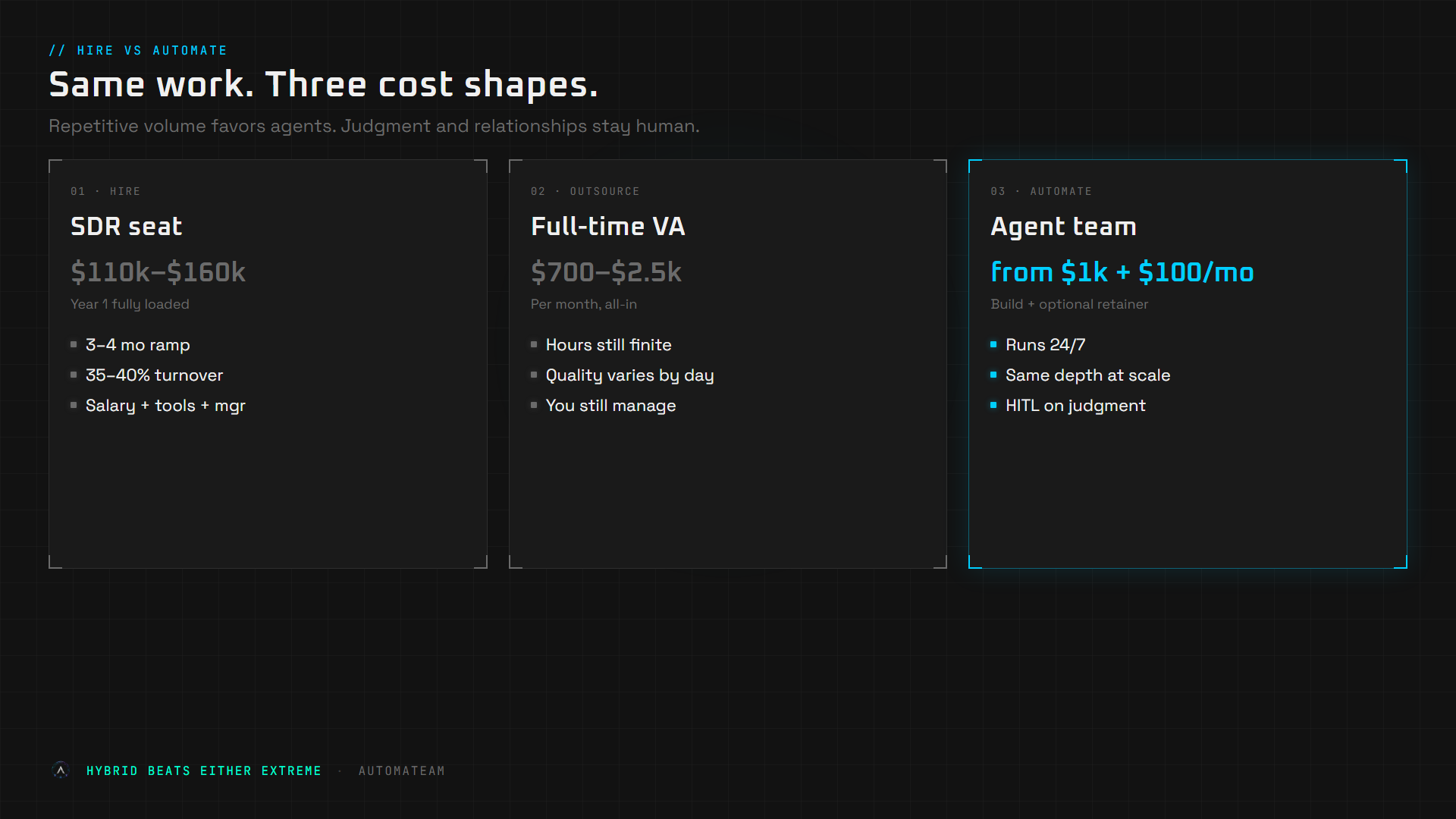
- Year-1 cash outlay: SDR $110k-$160k+ fully loaded; VA ~$8k-$30k; agent team typically low four figures build + low four figures retainer
- Time to useful output: SDR 8-14 weeks common; VA days to weeks; agent team: scoped build, then minutes per batch
- Consistency: humans vary by day; agents apply the same depth at scale
- Coverage: humans work shifts; agents run overnight and weekends
- Risk control: humans can improvise; agents need guardrails and human-in-the-loop on sends
- Best fit: SDR for live selling; VA for messy admin; agents for repeatable research, drafting, routing, and ops loops
If your bottleneck is "we cannot afford another $120k seat but we still need pipeline," agents are usually the better next unit of capacity. If your bottleneck is "nobody owns the customer relationship," hire a human and give them agents underneath.
Where do humans still beat AI agents?
Humans still win at trust, negotiation, brand taste, novel exceptions, and accountability. Automate the draft and the dig; keep a person on the decision that can lose you a client or a deal.
- Closing and negotiation: price, terms, and reading the room
- Relationship ownership: account management, partnerships, founder-led sales
- Brand and strategy: what you should say, not only how to say it faster
- Novel edge cases: one-off legal, compliance, or customer situations with no template
- Final approval on outbound: cold email, social publish, refunds, anything public
This is also why "replace every employee with AI" is a bad default. TIME's Sonora story worked because agents took setter volume and software sprawl. Hospitable's story worked because support and code volume scaled without tripling headcount. Both still needed people who could steer the system. AutomaTeam's default is the same: agents draft and execute; humans approve what leaves the building.
What does a hybrid humans-plus-agents model look like?
A hybrid model keeps a small human core for judgment and client trust, then adds agents for research, first drafts, enrichment, routing, and scheduling. You stop hiring for throughput you can systemize, and you hire when the job is mostly people work.
A simple decision rule
- Write down the weekly hours spent on the task and whether the output shape repeats.
- If it repeats and volume is rising, scope an agent before you open a job req.
- If it needs empathy, negotiation, or taste every time, hire (or keep) a human and give them agent support.
- Put human-in-the-loop on anything that sends, publishes, refunds, or commits the brand.
- Measure success in hours returned and quality held, not in headcount cut for its own sake.
That last point matters. Economists already warn about an "AI layoff trap" where firms cut capacity they later need. The healthier operator move in 2026 is capacity multiplication: agents handle work that previously sat undone or ate your evenings, while your people spend more time on revenue and relationships.
If you want that mapped to your stack, book a Strategic Scope call. We will tell you what to automate first, what should stay human, and what a build would cost. For more use cases by function, see What can AI agents do for my business?.
Frequently asked questions
Is an AI agent cheaper than a virtual assistant?
Usually yes for high-volume, repeatable work. A full-time VA often costs $700 to $2,500 per month depending on location and agency model, and still has finite hours. A custom AutomaTeam agent starts from a $500 to $1,000+ build with an optional retainer from $100 per month, then runs the same workflow overnight without hourly burn. A VA can still win when the work is messy, exception-heavy, or needs a human presence in chat and email.
Can AI agents replace employees?
AI agents can replace specific repeatable roles or role slices such as prospecting research, first-draft outreach, ticket triage, and scheduling. They should not replace the humans who own relationships, negotiation, brand judgment, and accountability. The practical 2026 pattern is fewer hours spent on busywork, not a promise that every seat disappears.
What roles should stay human?
Keep humans on closing, account ownership, strategy, creative direction, compliance-sensitive decisions, and final approval for anything that sends or publishes. Give those people agents for research, drafts, enrichment, and routing so their time goes to judgment instead of copy-paste.
Should I hire an SDR or build an AI lead gen system?
If you need someone to run live conversations and own pipeline quality end to end, hire an SDR (or AE) and automate their research and first drafts. If your main gap is producing qualified outreach volume without a six-figure seat, build an AI lead gen system first. Many teams do both: agents fill the top of funnel, humans take meetings.
How do I decide what to automate first?
Start with the weekly task that is high volume, rules-based, and painful when it slips: lead research, outreach drafts, intake routing, reporting, or content packaging. Avoid starting with one-off strategy work. AutomaTeam uses a Strategic Scope call to rank workflows by hours returned and risk, then builds the first agent or agent team against that shortlist.
See what this looks like for your business
Book a free 15-minute Strategic Scope. We map your manual work and tell you honestly what is worth automating.